Blood Brothers
Blood Brothers is a devastatingly effective exploration of social class, fate, and the nature versus nurture debate, wrapped in the engaging format of a musical play. Studying this text rewards candidates who can unpick Willy Russell's use of dramatic irony, contrast, and non-naturalistic staging to reveal the tragic consequences of societal inequality in Thatcher's Britain.
Study Notes
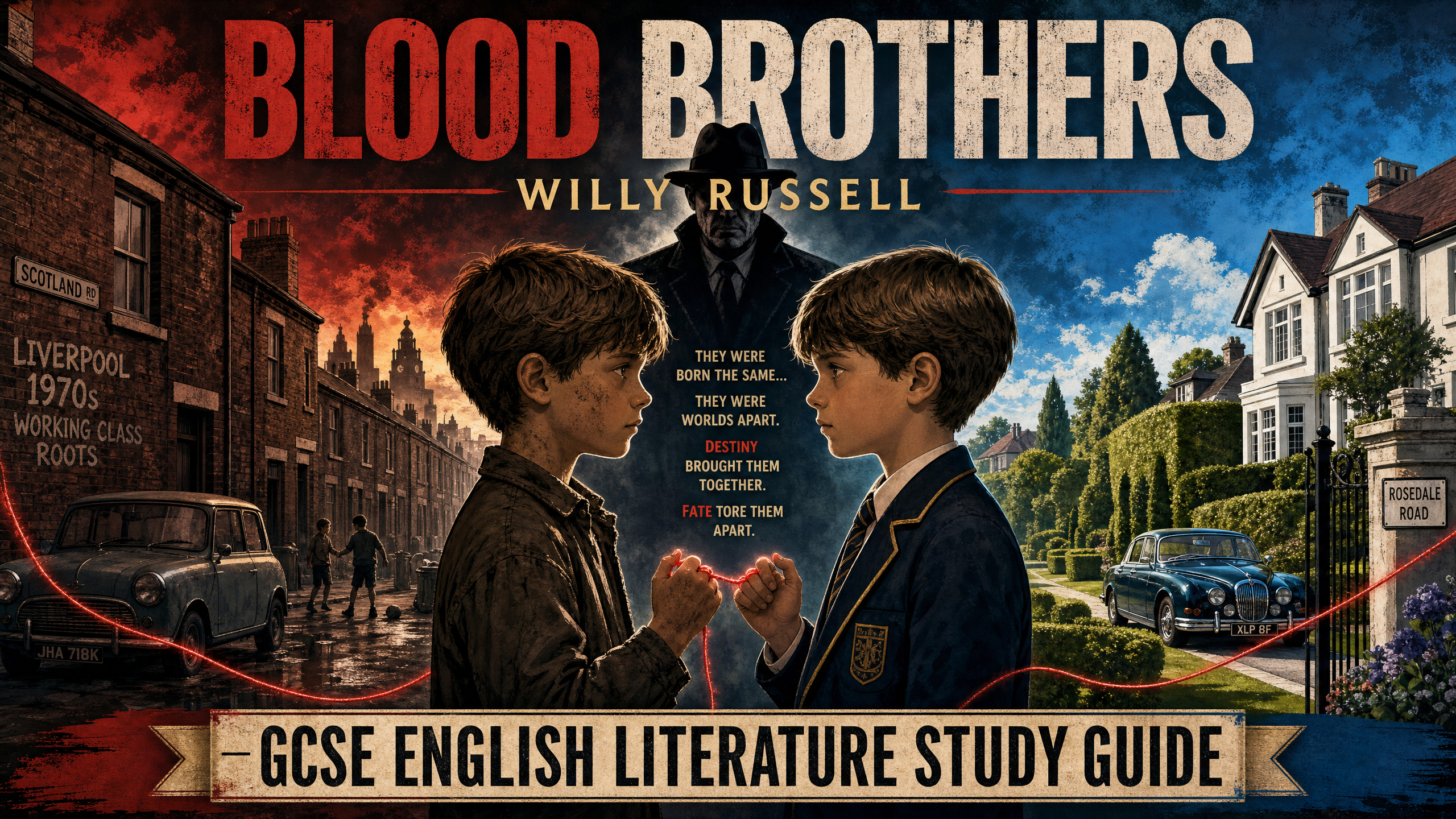
Overview
Willy Russell's Blood Brothers is a cornerstone text for GCSE English Literature because it demands that candidates engage not just with a narrative, but with the mechanics of drama and the profound impact of social context. Examiners are looking for students who understand that this is a play—a construct designed for an audience. To achieve the highest marks (Levels 5 and 6), you must move beyond plot summary and critically analyse how Russell uses structural devices like the omnipresent Narrator, recurring musical motifs, and stark linguistic contrasts to construct a tragedy that blames society, rather than fate, for the destruction of its protagonists.
Listen to our comprehensive audio guide for a deep dive into the themes and exam techniques:
Plot/Content Overview
Act One establishes the tragic premise. Mrs Johnstone, a struggling single mother in Liverpool, discovers she is pregnant with twins. Desperate, she agrees to give one away to her wealthy, childless employer, Mrs Lyons. The boys, Mickey (working-class) and Edward (middle-class), grow up separately but meet by chance at age seven, becoming "blood brothers." Their contrasting upbringings are highlighted through language, discipline, and opportunity. Mrs Lyons, terrified of the boys discovering the truth, forces her family to move away, soon followed by the Johnstones who are relocated by the council.
Act Two traces their adolescent and adult lives. The boys reunite as teenagers, but the class divide begins to fracture their bond. While Edward goes to university, Mickey faces unemployment, a rushed marriage to Linda, and a descent into crime and depression following a botched robbery with his brother Sammy. Linda turns to Edward for support, sparking Mickey's final, fatal confrontation with his twin. The play ends as it began: with the deaths of both brothers, fulfilling the Narrator's prophecy.
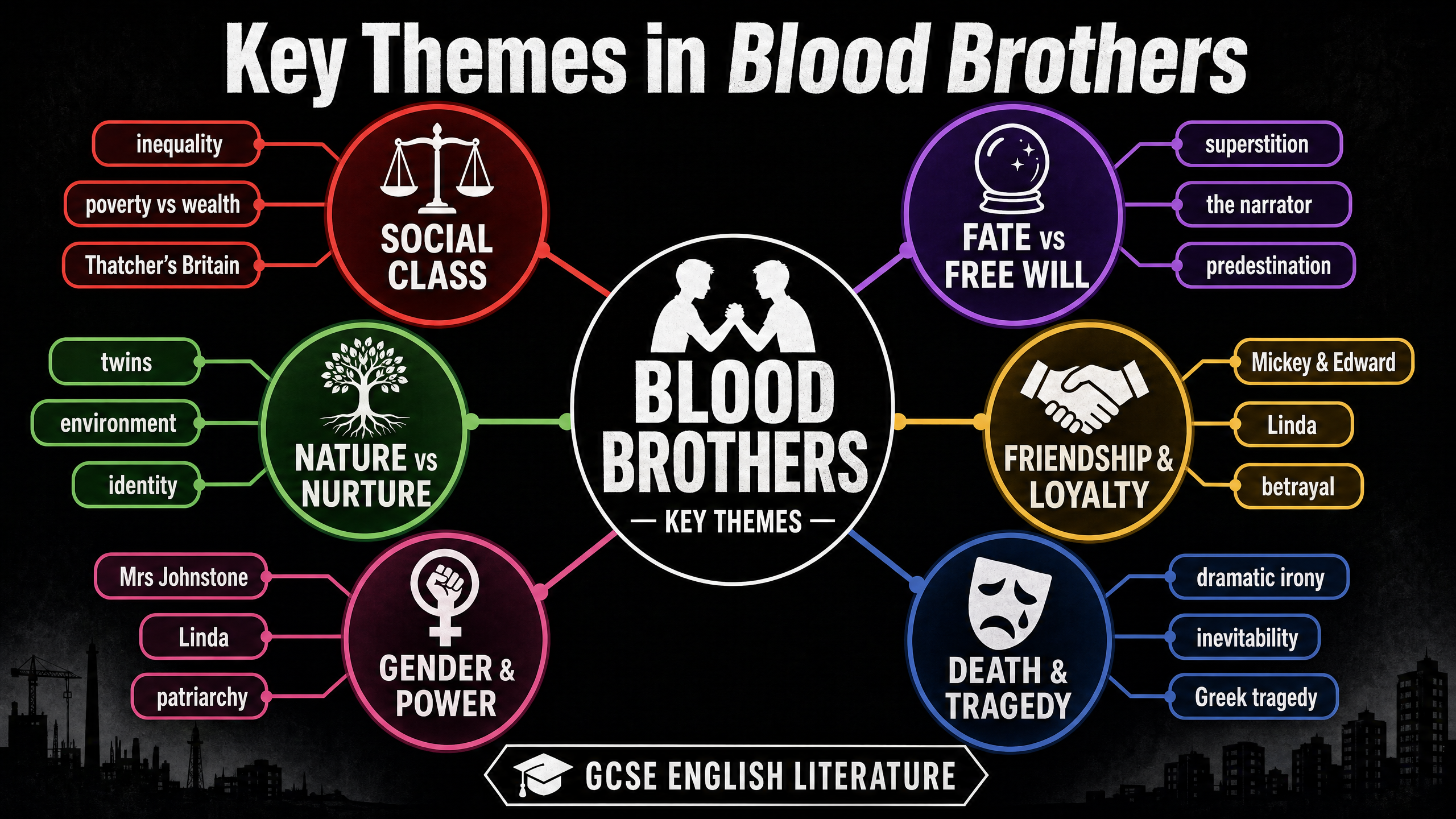
Themes
Theme 1: Social Class and Inequality
Social class is the inescapable force that dictates the characters' destinies. Russell uses the twins as a controlled experiment to demonstrate the devastating impact of poverty and the protective bubble of wealth. The tragedy arises not from the boys' inherent flaws, but from a society that denies Mickey opportunities while handing them to Edward.
Key Quotes:
- "I don't wanna be like... like... like a friggin' Mary Ellen." (Mickey, Act 1) - Highlights the defensive, hardened exterior demanded by his working-class environment, contrasted with Edward's sheltered innocence.
- "And do we blame superstition for what came to pass? / Or could it be what we, the English, have come to know as class?" (Narrator, Act 2) - Russell explicitly directs the audience to view the tragedy through a Marxist lens, identifying systemic inequality as the true villain.
Theme 2: Nature vs. Nurture
Russell explores whether our identities are determined by genetics (nature) or our environment (nurture). Despite sharing the same DNA, Mickey and Edward develop vastly different vocabularies, prospects, and coping mechanisms. However, their innate connection suggests that some core humanity transcends class, even if society ultimately destroys it.
Key Quotes:
- "You're a fuckin' thick prick." (Mickey to Edward, Act 2) - Mickey's frustration stems from his realization that their differences are purely circumstantial, yet insurmountable.
- "Why didn't you give me away? I could have been him!" (Mickey, Act 2) - The climax of the play; Mickey's tragic realization that his suffering was not inevitable, but the result of a choice dictated by poverty.
Theme 3: Fate, Superstition, and Inevitability
The play is framed as a tragedy from the prologue. The Narrator acts as a Greek chorus, constantly reminding the audience of the impending doom. However, Russell subverts this by suggesting that what appears to be "fate" or "superstition" is actually the inevitable outcome of a rigid class system.
Key Quotes:
- "Did you never hear of the mother, so cruel, / There's a stone in place of her heart?" (Narrator, Prologue) - Establishes the judgmental societal view of Mrs Johnstone, which the play then systematically dismantles.
- "You know the devil's got your number." (Narrator, recurring) - A motif that builds tension and reinforces the inescapable nature of the boys' trajectory.
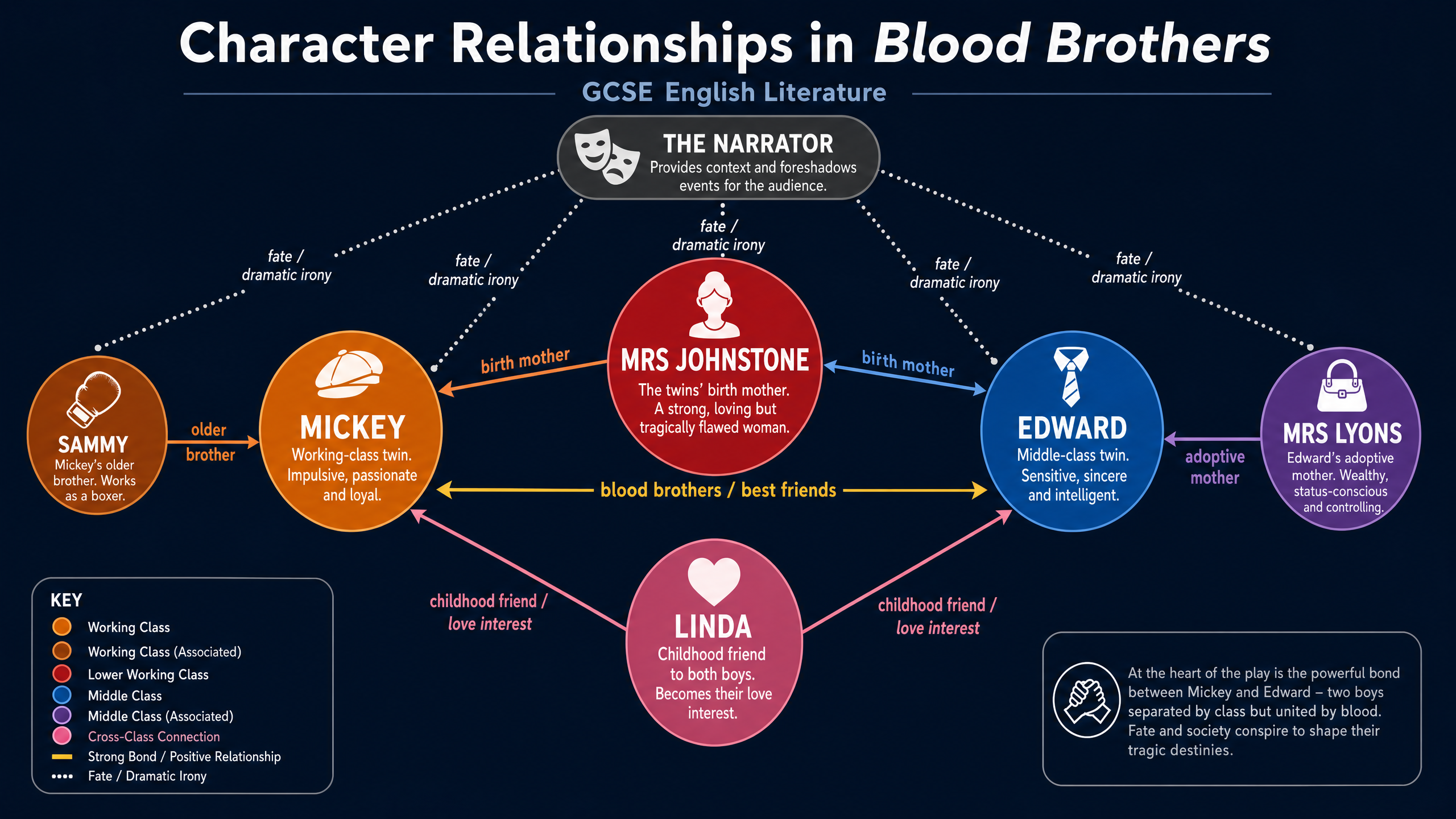
Character Analysis
Mickey Johnstone
Role: The tragic victim of working-class disenfranchisement.
Key Traits: Loyal, passionate, impulsive, ultimately broken.
Character Arc: Transitions from a joyful, imaginative child to a resentful, unemployed, and clinically depressed adult. His arc represents the crushing weight of systemic poverty.
Essential Quotes:
- "I wish I was our Sammy." (Act 1)
- "That was kids' stuff, Eddie. Didn't anyone tell y'? But I suppose you still are a kid, aren't y'?" (Act 2)
Edward Lyons
Role: The beneficiary of middle-class privilege.
Key Traits: Sheltered, well-meaning, naive, ultimately complicit.
Character Arc: Remains relatively static in his optimism, protected by wealth. His inability to truly understand Mickey's struggles highlights the empathy gap created by class division.
Essential Quotes:
- "You say smashing things, don't you?" (Act 1)
- "I've got money, plenty of it." (Act 2)
Mrs Johnstone
Role: The sympathetic heart of the play; a victim of circumstance.
Key Traits: Loving, superstitious, trapped by poverty.
Character Arc: Remains loving but is constantly punished by a society that judges her for her poverty rather than her maternal devotion.
Essential Quotes:
- "By the time I was twenty-five, I looked like forty-two." (Act 1)
- "Tell me it's not true." (Act 2)
Writer's Methods
Russell employs several key dramatic techniques that examiners expect you to analyse:
- The Narrator: Functions as a Brechtian device, breaking the fourth wall to ensure the audience remains critical rather than purely emotional. He represents fate, societal judgment, and the inescapable past.
- Dramatic Irony: Established in the prologue. The audience's foreknowledge of the twins' deaths creates a pervasive sense of tragedy and heightens the emotional impact of their childhood innocence.
- Linguistic Contrast: Russell uses dialect, register, and expletives to delineate class. Mickey's non-standard grammar contrasts sharply with Edward's received pronunciation, making the social divide audible.
- Musical Motifs: Recurring songs (e.g., "Marilyn Monroe," "Shoes Upon the Table") act as structural anchors, highlighting the passage of time and the deterioration of the characters' hopes.
Context
To achieve high marks in AO3, you must integrate context seamlessly. Blood Brothers is deeply rooted in the socio-economic landscape of 1970s and 1980s Liverpool. The decline of traditional manufacturing industries led to mass unemployment, which is directly reflected in Mickey's redundancy. The play can be read as a critique of Margaret Thatcher's conservative policies, which emphasized individualism and dismantled social safety nets, disproportionately affecting working-class communities like the Johnstones. Russell uses the microcosm of the two families to critique this macrocosmic societal shift.
Visual Resources
2 diagrams and illustrations
Interactive Diagrams
1 interactive diagram to visualise key concepts
Conceptual Flow Outline
The Tragic Trajectory of the Twins
Worked Examples
2 detailed examples with solutions and examiner commentary
Practice Questions
Test your understanding — click to reveal model answers
How does Russell use the character of the Narrator to explore the theme of fate? (30 marks + 4 AO4)
Hint: Consider how the Narrator acts as a constant reminder of the prologue, and whether he truly represents 'fate' or if he is actually the voice of societal judgment.
Explore how Russell presents the relationship between Mickey and Linda. (30 marks + 4 AO4)
Hint: Track their relationship from childhood innocence through to the crushing pressures of adulthood, unemployment, and depression.
How is the theme of childhood presented in Blood Brothers? (30 marks + 4 AO4)
Hint: Contrast the freedom of their childhood with the rigid, inescapable realities of their adulthood.
Starting with the final scene, explore how Russell creates a sense of tragedy in the play. (30 marks + 4 AO4)
Hint: Focus on the dramatic irony, the staging, and Mickey's realization of what his life could have been.